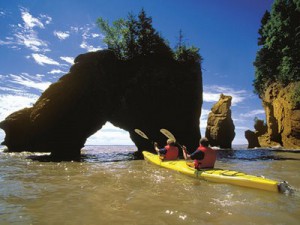
Explore some of the last remaining wilderness in southern New Brunswick, visit the oldest lighthouse on the province’s mainland, walk the ocean floor and witness the awesome forces of the Bay of Fundy. Popular activities in Albert County include biking, bird watching, canoeing, caving, climbing, hiking, horseback riding, nature walks, rappelling, and sea kayaking.
Population: Approx. 5000
Community Links:
http://www.albertcountytourism.com/
http://www.thehopewellrocks.ca/
Fundy National Park
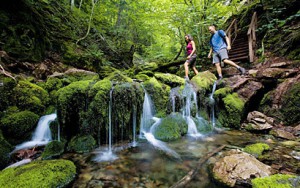
In the place where the Caledonia Highlands meet the fog-generating Bay of Fundy you will find Fundy National Park. New Brunswick’s first national park, Fundy’s coastline is shaped daily by the bay’s giant tides. Fundy National Park is home to over 260 species of birds, various amphibians and reptiles (including three rare types of salamanders) and nearly forty species of mammals.
There are also two interesting rock formations in the park. The gray and beige Owls Head cliffs are composed of sandstone and Point Wolfe holds the oldest rocks in Fundy National Park formed by volcanoes and the movements of the continents. Go hiking, biking or take a refreshing swim. Just outside the park, visit the fishing village of Alma, for great, fresh seafood.
Visitor Centre is open daily 8am-10pm June-Labour Day. Admission charged.
Cape Enrage
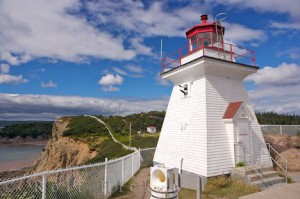
Off the beaten path, the Cape Enrage Lighthouse is the oldest lighthouse on mainland New Brunswick; in operation since 1848. Even on a calm summer’s day, the wind on top of these cliffs has been referred to many a time as ‘cold and blistering’. At the same time, however, Cape Enrage is a wonderful location to view the Bay of Fundy and for the adventurous, a great place for rappelling.
Mary’s Point Bird Sanctuary
Mary’s Point is one of the best places along the Bay of Fundy, and perhaps the world, for viewing shorebirds. Hundreds of thousands of semipalmated sandpipers stop here each summer during their migration from their widespread Arctic breeding grounds to their winter home of South America. Why? Well, quite simply they come here to get fat.

Although these cute creatures have over 1000sq. kilometers of the Bay to choose from at low tide, a distinct preference has been shown or Grande-Anse, Starrs Point, Evangeline Beach and, the seemingly most important destination, Mary’s Point. The birds follow the tide line as it advances and recedes. At high tide the sandpipers roost, but as the waters retreat the birds scurry from one hole to the next. Using sight and their relatively long bills, each sandpiper consumes between 9600-23000 mud shrimp each tide cycle.
During their time in Fundy they double their lean weight of only 20 grams, but this is necessary to complete their migration. After leaving Fundy the sandpipers travel at an average of 60km per hour and their non-stop flight takes approximately 40 to 60 hours, which nearly depletes their entire fat reserve. Of the two million birds that travel along the Atlantic Flyway each year, three-quarters stop in the Fundy region, making it the most important stopping point along the Eastern seaboard. Mary’s Point Bird Sanctuary is protected as a part of the Shepody National Wildlife Area.
**Note: The first semi-palmated sandpipers generally do not arrive in Fundy until mid-July.
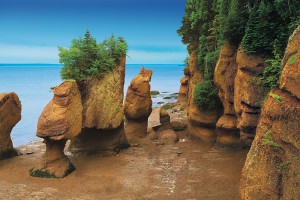
Hopewell Rocks: Tidal Exploration Site
At low tide, walk the ocean floor at Hopewell Cape. Only accessible three hours before and after low tide, Hopewell’s “Flower Pot” Rocks truly showcase the vertical variance of the tides. Walk the base of these amazing rock formations, hear the tale of how the native god Glooscap created the tides and delve into rich ecosystems.
Tides vary daily. Admission charged.
Albert County Museum
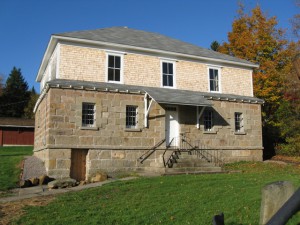
Promoting the history and heritage of Albert County and its people, the Albert County Museum reflects on the life and times of the region’s pioneers. Seafaring, shipbuilding, lumbering, mining and farming were all popular industries within this unique region, and a visit to this museum will introduce you not only to the industrial history of Albert Country, but also the folks who lived and worked here.
Discover fascinating books and newspapers, detailed maps, original documents from County records, a video of a schooner loading lumber off Alma in the 1940’s and numerous pictures of people and buildings. Also, for those researching their ancestry, the Albert County Museum is an invaluable resource for birth and death records, census records and even a few complete family trees.
Open June 12-September 15, 9:30am-5:30pm. Admission charged.
Salem and Hillsborough Railroad
A museum and tourist railroad, the Salem & Hillsborough Railroad is an interesting attraction found in Hillsborough, New Brunswick. In the museum discover an extensive collection of railway artifacts and equipment, then perhaps enjoy a relaxing ride through the beautiful countryside on the Salem & Hillsborough Railroad, an 11km stretch of track formerly owned by the Canadian National Railway Company. Admission charged.
edward hollingsworth
use to work for the bill lynch shows when the fair there was on lovely place to visit friendly people
Tom ILges
Can you tell us the mileage to the Hopewell Rocks ( flower pot ) from St Johns New Brunswick?