|
Not only is the Bay of Fundy home to the world’s highest tides, but it is also a region bursting with natural phenomena, historic and cultural anecdotes and thrilling adventures.
|
With every foot the tides rise and fall, new and different experiences are revealed. With every foot the tides rise and fall, yet another reason to visit the Bay of Fundy is uncovered.
In the coming paragraphs discover fifty enticing reasons, one reason for each foot of tidal water, to visit the Bay of Fundy. |
ACADIAN HERITAGE In a few distinct communities along the Fundy shoreline, observe the tri-coloured Acadian flag proudly flying from many homes and public buildings.
Travel the French Acadian Shore between Yarmouth and Digby, Nova Scotia. Set on the Baie Sainte Marie, the large community known as Clare was first settled by Acadians in 1768 (Municipality of Clare, 2005). The language spoken here today is reminiscent of 17th century French with an interesting twist of a few Mi’kmaw and English words. It is along this shore that you will discover one of the most celebrated Acadian churches.
Nearer the head of the Bay of Fundy, the Grand Pré National Historic Site commemorates Acadian culture and the Deportation of 1755. Featuring 14 acres of formal gardens, the site is home to beautiful monuments and statues. In addition, this 17th-18th century Acadian village is the scenic setting for Longfellow's famous poem Evangeline: A Tale of Acadie.
In New Brunswick visit the birthplace of New Acadia. In Memramcook, a valley filled with history, culture and striking scenery, hear tales of the Acadian Odyssey when you visit Monument-Lefebvre.
AIR Whether it is described as clean, cool, crisp or salty, Bay of Fundy air is purely refreshing.
|
BEACHES Sea, sand and surf. The Bay of Fundy is home to miles of unspoiled, uncrowded saltwater beaches. The perfect place to relax in the sun, play in the ocean’s waves or take a peaceful stroll. Find interesting driftwood and shells and colorful, smooth stones left behind by the tides. On a hot summer’s day, brave the cool waters of Fundy and take a refreshing dip. |
|
BED & BREAKFASTS/COUNTRY INNS Innkeepers in the Fundy region pride themselves on providing their guests with warm hospitality and well-appointed accommodations in a relaxed, tranquil environment.
Whether you prefer to stay in a country, historic or classic inn or be welcomed into a local bed and breakfast, BayofFundy.com will find the accommodation that best suits your needs. With an average Canada Select rating of 4-Star, you can be guaranteed that our partners will provide you an enjoyable, comfortable stay.
BIRDS Over 360 species of birds have been spotted throughout the Bay of Fundy region, including such endangered species as the peregrine falcon and the piping plover. The Bay of Fundy is a preferred destination for many birdwatchers, particularly during migration season, due to its prime location along the Atlantic Flyway.
Of the two million birds that travel along the Atlantic Flyway each year, three-quarters stop in the Fundy region, making it the most important stopping point along the Eastern seaboard (Thurston, 1990). One such species is the semipalmated sandpiper. Hundreds of thousands of these sandpipers stop here each summer during migration from their widespread Arctic breeding grounds to their winter homes in South America.
CHURCHES There are a number of historic churches to be found within the communities that line the Bay of Fundy.
Along Nova Scotia’s French Acadian Shore, discover one of the finest and most celebrated Acadian churches. An engineering marvel, St. Mary’s Church was built between 1903-1905 in the form of a cross and is the tallest and largest wooden church in North America (ExploreNovaScotia, 2005).
In New Brunswick both the City of Saint John and The Village of Memramcook are home to many churches with interesting histories of their own.
|
CURRENCY Although the exchange rates fluctuate, the US dollar is worth more than the Canadian dollar. Therefore Americans vacationing along the Bay of Fundy receive more “bang for their buck” and can stretch their dollar further than if traveling at home. |
In addition, non-Canadian visitors are eligible to apply to the Canada Customs and Revenue Agency for a tax refund upon their return to the United States.
DEEP-SEA FISHING Set out on the high seas, cast your line and reel in the catch. Popular catch in the Bay of Fundy include mackerel, pollack, flounder, cod, haddock, halibut and shark.
DIGBY SCALLOPS Digby, Nova Scotia, a coastal community found on Bay of Fundy, is home to the largest inshore scallop fleet in the world and the famous sweet and plump Digby Scallop.
Other popular seafood found in this region includes clams, mussels, salmon, haddock, halibut, shrimp and of course… lobster.
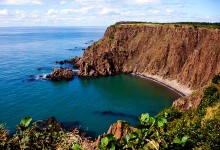
DIVERSE COASTLINE Nowhere but the Bay of Fundy can combine the strength of the highest, most powerful tides in the world with the natural beauty of a diverse, unspoiled shoreline. Discover rich eco-systems of bogs and marshes, towering sea stacks and cliffs and both sand and rock beaches. In addition to the natural diversity of the coast, you will find the region as a whole equally varied and intriguing.
DULSE – THE WORLD’S BEST Somewhat of an acquired taste, dulse is an edible red seaweed that grows in intertidal zones in the North Atlantic and Northwest Pacific Oceans. Dulse picked off the coast of Grand Manan Island is said to be the best in the world, specifically that harvested in Dark Harbour. The high cliffs along this western section of the island shade the intertidal zones, protecting the dulse from too much sunlight and therefore producing a darker, thicker and more flavourful seaweed. During the summer months, dulse grows so fast that the same shores may be picked every two weeks.
Dulse is an excellent source of dietary requirements. One handful of dulse contains 100% of the daily-recommended intake of Vitamin B6, 66% of B12, a day’s supply of iron and fluoride and is also relatively low in sodium while high in potassium (Grand Manan Tourism Association, 2005).
|
FALL FOLIAGE Witness the ebb and flow of some of the highest tides in the world and enjoy spectacular scenery enhanced by leaves at all stages of transformation. Gorgeous greens, golden yellows, vibrant oranges and fiery reds. |
|
The added bonus of “leaf watching” along the Fundy shores is the lack of crowds. Unlike fall foliage tours throughout New England, where so many people flock each year, brilliant Maritime foliage has been a long-kept secret.
FESTIVALS & EVENTS The communities, towns and cities that line the shores of the Bay of Fundy play host to many exciting festivals and events throughout the year. In addition to annual festivals celebrating Loyalist and Acadian heritage, there are events that mark the seasons, such as apple blossom or harvest festivals, show an appreciation for local seafood, such as Scallop Days, and other fantastic favourites, such as Saint John’s much-acclaimed Festival By The Sea and Sussex’s Atlantic Balloon Fiesta. For some, however, it is the autumn, pumpkin-themed events that win first prize for originality, including the Pumpkin People Festival and the Windsor-West Hants Pumpkin Regatta.
Also throughout the summer months, while traveling through some of Fundy’s neighbourhoods, discover exceptional theatrical performances put on by local theatre groups.
FIRST EUROPEAN SETTLEMENT Located at the mouth of the Ste Croix River, an international boundary between Canada and the United States, Ste Croix Island is the location of North America's first significant European settlement. In the summer of 1604, approximately eighty French colonists, led by Pierre Dugua, Sieur de Mons, and Samuel de Champlain, established a colony on Ste Croix Island. This the first winter in "Nouvelle France", however, proved difficult. Due to a shortage of fresh drinking water and the lack of fresh fruits and vegetables, nearly half of the settlers fell ill to scurvy and died (Parks Canada, 2005).
After exploring more of the coast in 1605, it was decided that the group should settle on the Annapolis Basin at “Port Royale” – the first permanent European settlement in North America (Parks Canada, 2005).
Ste Croix Island is an International Historic Site, a monument to the beginning of Canada and the United States, and Port Royal is a National Historic Site of Canada.
|
FISHING VILLAGES The fishing industry is a large employer throughout parts of the Fundy region and therefore the appearance of scenic fishing weirs off the coast and historic fishing villages along the shores are common. In New Brunswick travel along Route 790, through the communities of Chance and Dipper Harbours and Maces Bay, and through St. Martins, Alma and the Fundy Isles to observe the comings and goings of the fishing boats. |
Likewise in Nova Scotia, specifically Halls Harbour and Digby, and in Eastport, Maine, stop to watch the ebb and flow of the tides, stroll the fishermen’s wharves and take a deep breath of the crisp, salty air. At low tide, remaining fishing boats are left high and dry, while at high tide, they sit almost parallel with some wharves. Perhaps purchase some fresh fish from a local fisherman as the day’s catch is unloaded.
FOG Fog, created by contrasting water and air temperatures, provides natural air conditioning on otherwise scorching days. Along the Fundy coast July is the warmest month, with an average temperature of 20ºC or 68ºF (Environment Canada, 2004).
While the Bay of Fundy is among the foggiest regions in the world, on such grey days it is easy to escape the Fundy’s thick fog banks by traveling just a few miles inland, where beautiful sunshine awaits. Inland temperatures during the month of July can climb easily to 25ºC or 77ºF (Environment Canada, 2004).
FOSSILS As you comb the beaches at low tide, discover many treasures revealed and left behind by the Fundy’s great tides, including fascinating fossils. One of the most popular locations along this coast for fossils is Joggins, Nova Scotia.
Located at the head of the Bay of Fundy, these 75-foot high cliffs are exposed to constant tidal action and as Fundy’s 50-foot tides erode the cliffs, new fossils are revealed including a rich variety of flora, diverse amphibian fauna, important trackways and some of the world’s first reptiles. The Joggins Fossil Cliffs became famous in 1851 with the discovery of fossilized tree trunks found in their original positions. When closer examined, tiny bones were noticed within these trunks that turned out to be one of the most important fossil discoveries in Nova Scotia. These remains were from one of the world’s first reptiles and evidence that land animals had lived during the Coal Age. Today the Joggins Fossil Cliffs are recognized as a world-class palaeontological site (Nova Scotia Museum, 1996.)
FUNDY ISLE ISLAND HOPPING Many people can say they have gone island hopping in the Mediterranean, Caribbean or the South Pacific, but how many can say they have hopped the Isles of Fundy? A collection of islands at the mouth of the Bay of Fundy, the Fundy Isles are a part of the Province of New Brunswick and are connected to the mainland, and each other, by ferry. The Fundy Isles’ only connection to the mainland is the Franklin D. Roosevelt Memorial Bridge at Lubec, Maine - the eastern most town in the United States – which brings travelers to Campobello Island.
|
GOLF Getaway from the busy city life and come to the Bay of Fundy, where tee times at incredibly scenic and challenging golf courses await you. Along the Fundy coast there are nearly forty 9- and 18-hole courses with an additional sixty courses within a relatively short drive from the Bay. |
|
Some of the highest rated courses in Canada can be found in the Maritime Provinces and golfing here can be described as nothing short of invigorating, rewarding and picturesque.
HIKING Miles upon miles of hiking trails wait to be explored along the coast that surrounds the magnificent Bay of Fundy. In Fundy’s many parks find trails suited to those looking for a leisurely hike as well as for those seeking a genuine challenge. Follow rugged trails to otherwise hidden, breathtaking coastal and forested territories, such as those found along the Fundy Footpath, stick to more traveled pathways that lead you to stunning rural vistas, like Cape Split, or take a more relaxed beach hike along Fundy’s pristine shoreline. Depending on your preference, you can choose to plot your own course or be led by a knowledgeable local guide.
HISTORIC SITES With over a dozen historic sites of national significance and numerous others of local interest, the Bay of Fundy has lots of legends, tales of war and cultural anecdotes to share with its guests. Whether taking a step back in time to the Acadian Deportation of 1755 or to a time where strained relations forced an incredible battle between Great Britain and the United States, visiting these historic sites is not only educational but truly fascinating. Also, as so many forts and towers were built overlooking the waters of Fundy, to observe activity and protect their respective towns from intruders, many of these historic sites offer stunning, panoramic harbour views.
LIGHTHOUSES There are approximately sixty lighthouses that line the shores of the Bay of Fundy, many of which have guided vessels and protected seafarers from rocky headlands for nearly two centuries. Two lighthouses of interest include Partridge Island Light and East Quoddy Light.
The first recorded lighthouse on the Bay of Fundy was lit on Partridge Island in 1791. Partridge Island was also the first quarantine station in Canada and home to the world’s first foghorn, invented by Robert Foulis in the 1850’s. (New Brunswick Community College – Saint John, 2000.)
Locally referred to as the Head Harbour Lighthouse, East Quoddy Light is one of Canada’s oldest lighthouses and is one of the most photographed lighthouses in the world.
LOBSTER Bay of Fundy lobster is considered by many to be the best-tasting lobster in the world. The Bay’s cold waters contribute to the quality of the meat, while the lobster’s Fundy diet gives the meat its special flavour (FundyLobster.com, 2003).
Allow BayofFundy.com to arrange an adventure for you that includes hauling in a lobster trap, learning cooking techniques, observing a cracking demonstration and savouring a complete lobster dinner.
|
LOYALIST HISTORY In 1783 the Treaty of Paris ended the American Revolution and approximately 40,000 Loyalists fled New England to establish a new life in Europe, England and other parts of British North America, including such Bay of Fundy neighbourhoods as Saint John and Weymouth. |
Immediately following the end of the American Revolution, 3000 Loyalists arrived in Saint John, followed by an additional 11,000 before the end of the year, establishing two settlements: Parr Town and Carleton (City of Saint John, 2005). Today visitors to Saint John can retrace the steps of the city’s founders by following the Loyalist Trail, which includes a visit to the spot where the first Loyalists arrived in May of 1783, the Old Loyalist Burial Ground in the centre of the city and Loyalist House museum.
Weymouth’s Loyalist history includes the arrival of many white and black loyalists with its most famous Loyalist settler being Lieutenant James Moody. During the American Revolution, Moody risked his life recruiting, gathering intelligence and freeing prisoners from behind enemy lines and was even referred to as “that villain Moody” by George Washington. James Moody is one of Weymouth’s founding fathers. (Weymouth Board of Trade, 2005.)
MACHIAS SEAL ISLAND Claimed by both Canada and the United States, Machias Seal Island is the seasonal home of approximately 4000 pairs of nesting terns, 500 pairs of nesting razorbills and, the general favorite, 1300 pairs of nesting Atlantic Puffins (Sea Watch Tours, 2003). Access to this small island is limited and landing is done at one’s own risk as the terrain can be quite slippery and uneven. Two companies from Maine and one from New Brunswick offer tours to Machias Seal Island.
Machias Seal Island Light is operated by Canadian Coast Guard and the sanctuary is protected by the Canadian Wildlife Service. The only human residents are the island’s two light keepers.
Truly a bird watcher’s paradise.
MAGNETIC HILL A phenomenon first noticed by local farmers in the 19th century, Magnetic Hill is located in Moncton, New Brunswick along the Fundy Coastal Drive. While traveling on this hill, farmers noticed that their horses were struggling to go downhill, yet on the return trip uphill the wagons would catch up to the horses’ feet. Today visitors to the region can drive to the foot of this hill, put their vehicles in neutral and coast backwards to the top of the hill. Some believe that Magnetic Hill is merely an optical illusion, while others say a large magnet has been buried at the hill’s peak.
MARITIME HOSPITALITY
While traveling along the Fundy coast, whether in rural communities, quaint towns or the city, you will experience warm, welcoming hospitality. As a general rule, Maritimers are friendly, helpful and unobtrusive.
MI’KMAW HERITAGE Long before the arrival of Acadian and British settlers, it was the native Mi’kmaw people who first lived on the shores of Fundy. Mi’kmaw legends show a genuine appreciation for the Bay’s uniqueness and explain the many mysteries that surround the various phenomena.
Mi’kmaw legend says that Fundy’s great tide was created when the man-god Glooscap decided he wanted to take a bath. Glooscap commanded Beaver to build a dam at the mouth of the Bay to trap the water for his bath. Whale was angered by this and demanded to know what had stopped the flow of the water. Glooscap then, not wanting to annoy Whale, instructed Beaver to break to dam, but Whale was too impatient. He began to break away at the dam with his tail and these great movements set Fundy’s waters in motion. To this very day the waters of the Bay continue to sway back and forth. (The Hopewell Rocks Ocean Tidal Exploration Site, 2004.)
|
There are also great Mi’kmaw tales to account for the creation of the Hopewell Rocks, Fundy’s towering sea cliffs, Nova Scotia’s Five Islands and the chocolate coloring of the Petitcodiac River. |
|
MUSEUMS While traveling throughout the Bay of Fundy region take time to visit some of its fascinating museums. Learn about the life and times of the region’s pioneers, local history and industry and see a variety of interesting exhibits.
In Saint John visit the oldest continuing museum in Canada and stroll through the Great Hall of Whales, the Ship Building Gallery and learn, in general, about the Province of New Brunswick. In Yarmouth visit the Firefighter’s Museum of Nova Scotia to view photos, recollections and thousands of artifacts that chronicle the history of firefighting throughout the province. And, in St. Stephen, visit The Chocolate Museum to hear the story of the Ganong brothers, who started their popular candy-making business in the late 1800's. Other out of the ordinary museums include a former scallop dragger, a sawmill and a museum dedicated to the history of the apple-growing industry.
|
NO CROWDS Compared to those surrounding large cities, such as Toronto, Boston and New York, the highways that join Fundy cities and towns are practically empty. There are no traffic jams allowing you to simply sit back and discover the joy of scenic driving. |
Compared to large urban centers, the sidewalks that line the streets of Fundy’s cities and towns are spacious. Stroll along these walkways, stopping to sightsee and window-shop at your leisure.
Compared to beaches in high-traffic tourist destinations, the beaches along the Fundy coast are nearly deserted. Come with your beach blanket, sunscreen and a good book and enjoy a relaxing day in solitude at the beach.
OLD SOW WHIRLPOOL Located in the Western Passage of the Passamaquoddy Bay, between Deer Island, NB and Eastport, ME, Old Sow is the largest natural whirlpool in the Western Hemisphere and the second largest in the world. Created in part by the Bay of Fundy’s tremendous tides rushing into a narrow passage, the submarine terrain of trenches and mountains and other nearby tidal waters also contribute to Old Sow’s activity (Old Sow Publishing, 2004). Although sometimes visible from land, the best way to truly appreciate this natural phenomenon is by chartered boat, operated by a qualified captain, and to actually sail through the whirlpool. The Old Sow Survivor’s Association provides “Survivors” with a special certificate to prove to friends and family that they successfully navigated one of the five significant whirlpools in the world!
OUTDOOR RECREATION In addition to deep-sea fishing, hiking and sea kayaking, there are many other thrilling outdoor activities to be sampled along Fundy’s coast.
Rappel off or climb up rugged cliffs facing the Bay of Fundy’s giant tides, explore undeveloped and wild caves or charter a scuba dive to meet some of the Bay’s interesting inhabitants
There is no doubt that the Bay of Fundy is a dream come true for all outdoor recreation enthusiasts.
|
PARKS While traveling along the Fundy coasts of Maine, New Brunswick and Nova Scotia, discover many diverse parks of international, national, provincial or state significance. Explore untamed, natural beauty, hike miles of rugged trails, observe rich eco-systems or watch the sunrise from the highest point along the Eastern seaboard north of Brazil. Perhaps pack a picnic and spend the day or merely drive through and appreciate the fantastic scenery. |
|
PHOTOGRAPHER’S PARADISE Countless fantastic photo opportunities lay along the Fundy coast. Whether looking for an urban or rural backdrop, surreal natural scenes or local culture shots, the Bay of Fundy is simply a photographer’s paradise. Imagine photographing one of the world’s few right whales as it breeches out of the Fundy waters or during fall foliage getting a picture so perfect of the colourful reflection on the water’s surface that you cannot tell which side is up. Imagine photographing the streetscapes of Canada’s first incorporated city as the sun sets, an endangered peregrine falcon soaring overhead or a bank of fog as it lifts off the Bay of Fundy. The possibilities are truly endless.
QUAINT ARTISAN STUDIOS & GALLERIES In addition to traditional souvenir shops, the shores of Fundy host terrific artisan studios and galleries. In communities such as Annapolis Royal, Hillsborough and St. Andrews discover a plenitude of local talent. Pottery, metal sculptures, fabric art, stained glass, watercolour, photography, handmade soaps, locally-crafted jewellery and more. Also, as you stroll the city streets, be sure to stop and peruse through the local galleries. You never know what treasures you may find!
RESORTS Looking for a resort holiday with a new twist? The Bay of Fundy offers its guests a traditional resort holiday in a non-traditional atmosphere. In New Brunswick stay in Canada’s oldest seaside resort town, St. Andrews by-the-Sea, at The Fairmont Algonquin Resort, in Digby, Nova Scotia, relaxing is made easy at The Pines Resort and in Maine discover the picturesque resort community of Bar Harbor.
|
REVERSING FALLS The famed Reversing Falls are a series of whirlpools and rapids caused by the world’s highest tides, found in the Bay of Fundy, meeting the St. John River in a rocky gorge. This is an incredible phenomenon that, to be truly appreciated, must be seen just before high and low tide. |
Although well-practiced kayakers enjoy testing their skills by paddling the rapids, the general public can experience the thrill of the Falls aboard a specially designed Jet Boat or from within a unique aquatic bubble.
RICH ECOSYSTEMS The Bay of Fundy’s rich ecosystems, including many bogs, marshes and mudflats, support the lives of numerous plants and animals.
In Quoddy Head State Park stroll the boardwalks through Carrying Place Cove Bog. A National Natural Landmark, this bog sustains a variety of rare plant life that can only survive in a northern climate (State of Maine, 2004). Review detailed interpretive panels to learn more about the bog and local wildlife.
Where the Provinces of Nova Scotia and New Brunswick meet discover the Tantramar Marshes. Comprised of both freshwater wetlands and saltwater marshes, the Tantramar Marshes are an important feeding ground for migratory waterfowl as well as many other species.
Mudflats, such as those frequented by semipalmated sandpipers at Mary’s Point, are an important source of nourishment to not only migratory birds, but also the clams, snails and crabs that inhabit the flats and some fish at high tide.
ROCK HOUNDING As Fundy’s giant tides erode the towering sea cliffs and wash the shores, many interesting rocks, zeolites and semi-precious stones are revealed.
Along the shores near Parrsboro, often described as a rock hounder’s paradise, mineral treasures such as amethyst and agate are common finds. In Fundy National Park discover two tale-telling rock formations. While the rocks found around Owls Head are made of sandstone, the volcanic rocks at Point Wolfe tell of the shifting of the continents and are comprised of white quartz veins, swirling folds and criss-crossing fractures (Parks Canada, 2004).
SCENERY The Bay of Fundy’s coastline is sculpted daily by the washing of the world’s highest tides, creating some of the country’s most breathtaking scenes and stunning panoramic vistas. Images of quaint fishing villages, historic streetscapes, weathered lighthouses, luscious wilderness and the deep-blue waters – all framed by an ever-changing landscape - will remain with you for many years to come.
|
SEA KAYAKING Experience the Bay of Fundy tides by sea kayak. Spend hours exploring the waters as you paddle along unspoiled shoreline, isolated coves, towering cliffs and fascinating sea caves. Observe bald eagles soaring overhead, numerous seabirds and perhaps the occasional seal or harbour porpoise. |
|
Allow local guides to fill you in on the history and geology of the region and explain the tides as you navigate through fishing weirs and soak up the sunshine. Some tours include stops on secluded beaches to provide kayakers with some time for beachcombing. Instruction is also provided for the inexperienced and a new appreciation of the outdoors is nearly guaranteed.
SILENCE The Bay of Fundy provides its visitors with the opportunity to hear nothing but the a few birds singing soft melodies, waves crashing on to the shores and the wind rustling through the countryside. Escape the hectic, urban lifestyle and the humdrum of daily routine to the solitude of the Bay of Fundy. Relax and enjoy the serene ambiance to feel refreshed and alive.
SLOW PACE Experience life in the slow lane. Although much gets done in a day, people are unhurried, there are no crowds and the lifestyle is set at a calm pace. Take time to appreciate your surroundings. The clean, cool air, breathtaking, natural beauty and friendly locals will help you acclimatize to this way of life.
SUNRISES & SUNSETS Pictures are painted in the sky every morning and evening along the shores of Fundy and from each vantage point a new portrait is created. With foregrounds such as charming fishing villages, historic cities and the Bay itself, images of sunrises and sunsets along the Fundy coast will long be embedded in your memory.
|
TIDAL BORE An incredible phenomenon seen in very few parts of the world, tidal bores are formed as tidal waters flow into outgoing rivers. Within the Bay of Fundy bores can be found in three locations: Petiticodiac River, Salmon River and Shubenacadie River. |
Perhaps take a ride on the tidal bore’s crest to witness, upclose, the incredible force of the Bay of Fundy’s giant tides rushing upstream. The tidal bore ranges from one to ten feet in height and can travel at speeds of eight miles per hour, depending on tidal and channel conditions (Shubenacadie River Runners, 2005; Petitcodiac Riverkeeper, 2004).
VINEYARDS & WINERIES Experience the romance of the grape along Nova Scotia’s Evangeline and Glooscap Trails. Visit the province’s growing wine region to not only enjoy fantastic wines but to also experience the region’s unique character.
Wolfville, seen by some as the cultural and intellectual centre of the Annapolis Valley, is quickly becoming recognized for the vineyards and wineries that sit on the town’s outskirts. In Grand Pré, stroll along the cobblestone walkways and beautifully landscaped grounds and enjoy the relaxed atmosphere. Perhaps take a “Tour and Tasting” to learn more about the vineyard and winery and conclude with a sample of an award-winning wine. Other fine products produced at this Nova Scotian winery include ice wine, apple wine and the famous Stutz cider. Nearby, in Falmouth, visit a vineyard and winery set on an original Acadian village. Take a tour of the vineyard and cellar before your wine tasting. Typical wines produced here include white, red, ice and Riesling. This small, family-owned vineyard also hosts the Harvest Wine Festival held each October. These are just two of the four wine producers located along the Evangeline Trail.
Within the Glooscap Trail, discover Nova Scotia’s premium fruit wine producer and the first all fruit winery in the province. Relax on the licensed patio and enjoy a glass of sangria, winter wine or apple, blueberry, cranberry, pear, raspberry or strawberry wine. Tours of the farm and winery are also available upon request.
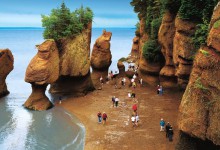
WALK ON THE OCEAN’S FLOOR During Fundy’s low tide you are literally able to walk, and explore, the ocean floor. Ground covered only a few short hours earlier, by many feet of water, is revealed and the potential for finding newly exposed treasures, such as fossils and semi-precious stones, make it easy to spend hours combing the shores. One of the more popular spots along the Fundy coast for “Walking on the Ocean Floor” is Hopewell Cape. Only accessible three hours before and after low tide, Hopewell’s “Flower Pot” Rocks truly showcase the vertical variance of the tides. Walk the base of these amazing rock formations and delve into rich ecosystems.
|
WHALE WATCHING The Bay of Fundy is one of the richest marine habitats in the world and is therefore the summer feeding ground for many marine mammals, seabirds and saltwater invertebrates. BayofFundy.com works with a number of reputable whale watching companies along the Bay who set out on the seas in a variety of vessels including catamarans, zodiacs, fishing boats and sailing yachts. |
|
When you take part in a whale watching adventure on the Bay of Fundy you can expect to see minke, fin- and humpback whales as well as the rarest large mammal on Earth – the North Atlantic Right Whale. Named for being the “right” whale to kill by 19th century whalers, there are only approximately 300 of these creatures alive today (Fisheries and Oceans Canada, 2004).
Other common sightings include harbour porpoise, dolphins, sharks, seals, bald eagles and a variety of seabird colonies, sometimes including the Atlantic Puffin. Sit back and appreciate the breathtaking scenery as you learn about the local fishing industries and the history of the Bay.
WILDERNESS & WILDLIFE Explore the expansive wilderness of Fundy National Park, travel the Fundy Trail Parkway to previously unreachable coastal areas, inspect the old-growth forests and steep ravines of Cape Chignecto Provincial Park or visit Brier Island to appreciate its wealth of wildflowers, orchids and the endangered Eastern Mountain Avens. Along the shores, in the water and soaring overhead, observe routines of the Bay of Fundy’s resident wildlife. Spot sandpipers and plovers scurrying across the mudflats, white-tailed deer taking a drink from rivers and lakes or perhaps a moose rising from a marshland snooze. In the skies witness the magnificent movements of bald eagles, ospreys and peregrine falcons. To view marine mammals and seabirds playing in their chilly, water home, take an enjoyable nature cruise.
WORLD’S HIGHEST TIDES Twice everyday the Bay of Fundy fills and empties of its 100 billion tonnes of water, creating the highest tides in the world. The height of the tide is 3.5 meters (11ft) along the southwest shore of Nova Scotia and steadily increases as the floodwaters travel up the 280 km (174 miles) of shoreline to the head of the Bay where the height of the tide can reach 16 meters (53ft). (Thurston, 1990.)
The force created by these mighty waters is equal to 8000 locomotives or 25 million horses at the Minas Channel (Thurston, 1990). This energy works within the Bay’s waters to stir up nutrients from the ocean floor, the mud flats and salt water marshes providing an abundance of food for the birds, whales, fish and bottom dwellers that visit or call Fundy home.
The effect of the world's highest tides on the Bay’s shores has created dramatic cliffs and awesome sea stacks. The red sandstone and volcanic rock have been worn away to reveal fossils from over 300 million years ago.
References City of Saint John. (2005). A Brief History. Retrieved January 5, 2005 from the World Wide Web: http://www.cityofsaintjohn.com/2.cfm?PageID=2-4-4
Environment Canada. (2004). Atlantic Climate Centre: Temperature: A Province of Contrasts. Retrieved January 3, 2005 from the World Wide Web: http://atlantic-web1.ns.gc.ca/climatecentre/default.asp?lang=En&n=7A6129C7-1#temperature
ExploreNovaScotia. (2005). ExploreNovaScotia. Retrieved January 3, 2005 from the World Wide Web: http://www.explorenovascotia.com
Fisheries and Oceans Canada. (2004). Species at Risk. Retrieved January 27, 2005 from the World Wide Web: http://www.dfo-mpo.gc.ca/species-especes/species/species_rightWhale_e.asp
FundyLobster.com. (2003). Bay of Fundy Lobster Facts. Retrieved December 30, 2004 from the World Wide Web: http://www.fundylobster.com/lobster.htm
Grand Manan Tourism Association. (2005). Welcome to Grand Manan & White Head Islands. Retrieved January 3, 2005 from the World Wide Web: http://www.grandmanannb.com
The Hopewell Rocks Ocean Tidal Exploration Site. (2004). Mi’kmaq Legends. Retrieved January 11, 2005 from the World Wide Web: http://www.thehopewellrocks.ca/english/legends.htm
Municipality of Clare. (2005). Baie Saint-Marie Nova Scotia’s French Acadian Shore History and Culture. Retrieved January 10, 2005 from the World Wide Web: http://www.baiesaintemarie.com/tourism/en/culture/history_and_culture.htm
New Brunswick Community College – Saint John. (2000). Patridge Island Light: Gateway to Canada. Retrieved December 30, 2004 from the World Wide Web: http://www.saintjohn.nbcc.nb.ca/~Heritage/PartridgeIsland/index.htm
Nova Scotia Museum. (1996). The Joggins Fossil Cliffs. Retrieved December 22, 2004 from the World Wide Web: http://museum.gov.ns.ca/places/joggins.html
Old Sow Publishing. (2004). Old Sow Whirlpool. Retrieved December 22, 2004 from the World Wide Web: http://www.oldsowwhirlpool.com
Parks Canada. (2004). Fundy National Park of Canada. Retrieved December 21, 2004 from the World Wide Web: http://www.pc.gc.ca/pn-np/nb/fundy/index_e.asp
Parks Canada (2005). Saint Croix Island International Historic Site. Retrieved January 10, 2005 from the World Wide Web: http://www.pc.gc.ca/lhn-nhs/nb/stCroix/index_e.asp
Petitcodiac Riverkeeper. (2004). The Tidal Bore. Retrieved January 4, 2005 from the World Wide Web: http://www.petitcodiac.org/riverkeeper/english/tidalbore/tidalBore.htm
Sea Watch Tours. (2003). Puffins & Machias Seal Island. Retrieved December 22, 2004 from the World Wide Web: http://www.seawatchtours.com/puffins.html
Shubenacadie River Runners. (2005). What Should I Know? Retrieved January 4, 2005 from the World Wide Web: http://www.tidalborerafting.com/
State of Maine. (2004). Quoddy Head State Park. Retrieved January 10, 2005 from the World Wide Web: http://state.me.us/cgi-bin/doc/parks/find_one_name.pl?park_id=10
Thurston, Harry. (1990). Tidal Life: A Natural History of the Bay of Fundy. Halifax, Nova Scotia: Nimbus Publishing Ltd.
Weymouth Board of Trade. (2005). Village of Weymouth: Village History. Retrieved January 3, 2005 from the World Wide Web: http://www.weymouthnovascotia.com
|